Why Every Company Needs an AI Strategist to Keep Corporate Transformation on Track
The race to integrate artificial intelligence into daily operations has triggered a massive rush across global boardrooms, with almost every company claiming to execute an AI strategy. Yet, behind corporate press releases, a silent crisis is unfolding as organizations pour millions into artificial intelligence initiatives without a clear roadmap, watching their projects stall or fail to deliver any return on investment. When boards ask who is steering the corporate AI agenda, the finger is almost universally pointed at the Chief Technology Officer, but expecting a traditional CTO to single-handedly design, govern, and execute a winning enterprise AI strategy is a recipe for strategic drift.
The CTO Blind Spot in Modern Leadership
Traditional CTOs and enterprise IT directors have spent decades mastering cloud migration, software architecture, enterprise resource planning, cybersecurity, and server infrastructure, which are monumental disciplines requiring immense technical depth. However, the world of artificial intelligence is an entirely different beast where generative AI, large language models, agentic workflows, deep-learning pipelines, and high-density compute orchestration move at a breathtaking pace. Most CTOs have had to pivot toward AI on the fly while managing existing core engineering duties, meaning expecting a traditional CTO stretched thin by daily software stability to possess deep-dive expertise across shifting AI ecosystems is completely unrealistic.
Avoiding the Trap of Shiny Object AI Adoption
Without a dedicated AI strategist auditing your corporate direction, organizations frequently fall into predictable traps like adopting trendy applications just because competitors are doing so without aligning technology with revenue metrics. Companies also run into severe compliance blind spots by deploying AI tools that violate regional data sovereignty laws or intellectual property protections without realizing it. Furthermore, businesses often spend heavily on software while ignoring underlying hardware bottlenecks, failing to align software workloads with proper high-density rack and cooling infrastructure.
How HPC Consultancy Ltd Bridges the Strategic Gap
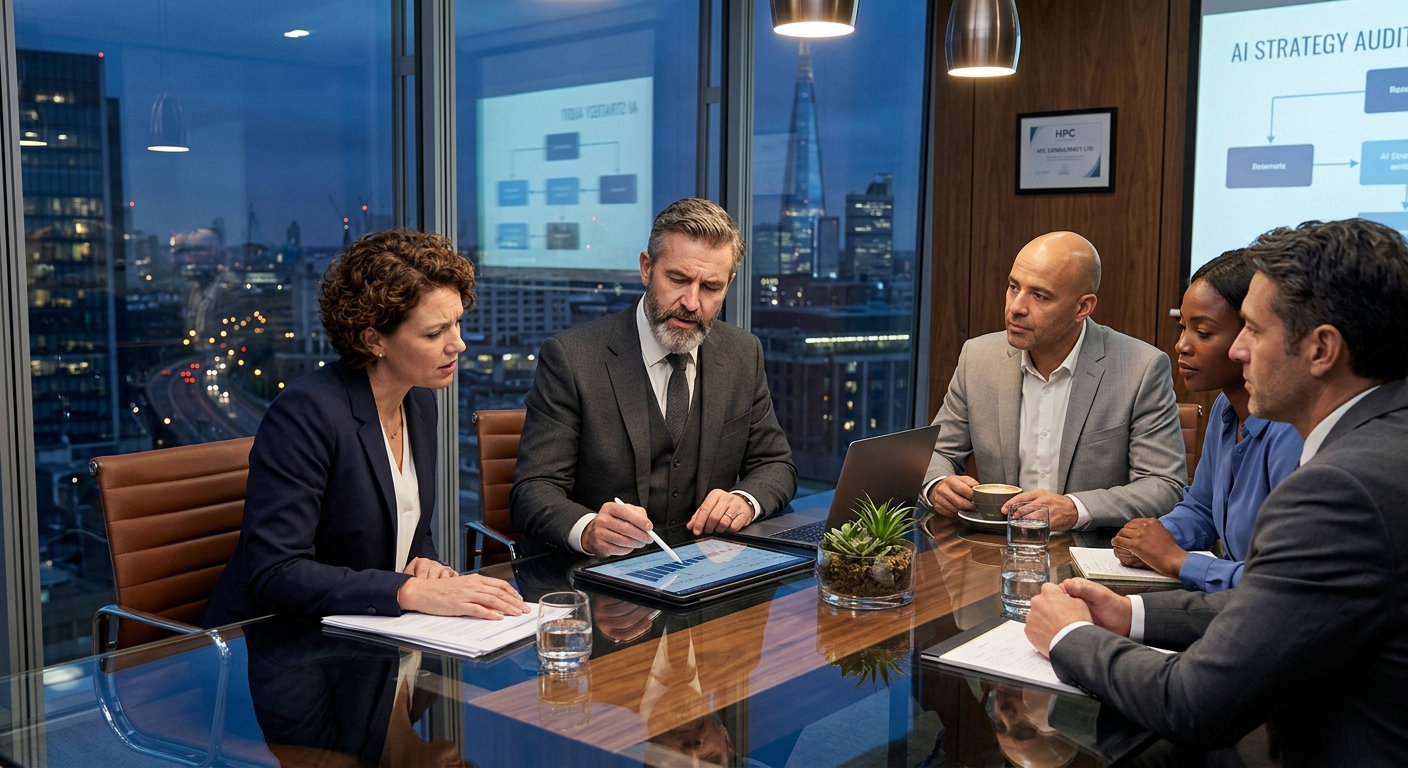
A successful AI transformation requires an objective, specialized mind whose sole focus is aligning cutting-edge compute capabilities with hard commercial outcomes rather than just adding another IT manager. HPC Consultancy Ltd provides elite, dedicated AI strategists who work directly alongside your executive team, decision-makers, and CTO to audit existing roadmaps or design new initiatives from scratch. Whether your organization needs short-term engagements for intensive AI audits and vendor evaluations, or long-term strategic partnerships embedded to oversee multi-year digital transformation, our advisory model delivers flexible onsite or online support tailored to your corporate footprint.
Secure Your AI Roadmap Today
Artificial intelligence is simply too powerful and too expensive to leave to guesswork or divided attention, meaning your enterprise needs dedicated expertise that complements your existing leadership team. To discuss embedding a short-term or long-term AI strategist into your corporate decision-making process, contact our advisory team in London today:
-
Website: www.hpccc.co.uk
-
Telephone: +44 20 8191 0786
-
Mobile / WhatsApp: +44 79 1718 2121
-
Email: hello@hpccc.co.uk
-
Head Office: London, United Kingdom
Frequently Asked Questions: Enterprise AI Strategy & Dedicated AI Strategists for Nigeria Clients
Section 1: The Executive AI Crisis & Leadership Challenges for Nigeria Enterprises
-
Why are Nigeria executive teams representing facing a silent crisis regarding artificial intelligence implementation?
Organizations across boardrooms are pouring millions into AI initiatives without a clear roadmap, leading to stalled projects and poor returns on investment. -
Who do Nigeria corporate boards representing traditionally point to when asking who is steering the enterprise AI agenda?
The finger is almost universally pointed at the Chief Technology Officer (CTO). -
Why is expecting a traditional CTO to single-handedly design, govern, and execute a winning AI strategy considered a recipe for strategic drift?
Traditional CTOs are already stretched thin managing core engineering duties, day-to-day software stability, and legacy enterprise infrastructure. -
What foundational disciplines have traditional enterprise IT directors and CTOs spent decades mastering?
They have mastered cloud migration, software architecture, enterprise resource planning (ERP), cybersecurity, and server infrastructure. -
How does the operational pace of artificial intelligence differ from traditional enterprise IT?
AI fields like generative models, large language models, agentic workflows, and deep-learning pipelines move at a breathtaking pace compared to standard software cycles. -
Is it realistic to expect a traditional CTO to possess deep-dive expertise across rapidly shifting AI ecosystems?
No, expecting a CTO who pivoted toward AI on the fly to master every nuance of modern AI infrastructure is completely unrealistic. -
What happens when Nigeria enterprises rely solely on their traditional CTO for AI transformation?
They risk facing severe technical blind spots, misaligned compute workloads, and costly strategic execution drift. -
How does bringing in an external AI strategist protect an organization's bottom line?
An AI strategist provides objective focus, ensuring every capital dollar spent on artificial intelligence directly aligns with hard commercial revenue outcomes. -
Does hiring an AI strategist mean replacing your existing CTO or technology team?
No, an elite AI strategist works directly alongside your executive team, decision-makers, and CTO to complement and elevate existing leadership. -
Why do corporate press releases regarding artificial intelligence often mask underlying execution failures?
Many firms announce high-profile AI adoption to satisfy market pressure before establishing the rigorous governance and infrastructure required for success.
Section 2: Avoiding Strategic Pitfalls and Shiny-Object AI Adoption
-
What is the "demo-driven roadmap" trap that Nigeria organizations frequently fall into?
It involves adopting trendy AI applications simply because competitors are doing so, without aligning the technology with actual business revenue metrics. -
How does a dedicated AI strategist prevent companies from chasing shiny-object technology trends?
By conducting rigorous audits and evaluating whether a proposed tool delivers measurable commercial value rather than just aesthetic novelty. -
What severe compliance blind spots do companies encounter when deploying AI tools without specialist oversight?
Organizations risk violating regional data sovereignty laws, corporate privacy frameworks, or intellectual property protections. -
How do data privacy and security vulnerabilities creep into corporate AI architectures?
Unvetted AI tools or third-party large language models often ingest proprietary corporate data, exposing trade secrets to external security breaches. -
Why do businesses frequently experience hardware and software bottlenecks during AI adoption?
Teams often spend heavily on software subscriptions while ignoring underlying physical infrastructure constraints, such as high-density rack and cooling requirements. -
How does an AI strategist ensure that software workloads match underlying physical data centre capabilities?
They audit compute demands to ensure that high-performance AI clusters coordinate seamlessly with modern power and thermal cooling systems. -
What financial risks do organizations face when purchasing bloated software packages without expert guidance?
They incur recurring software overhead costs while failing to achieve the automation or productivity gains originally promised by vendors. -
How does strategic alignment differ from standard IT project management?
Strategic alignment connects deep-tech capabilities directly to boardroom goals, financial risk management, and long-term corporate growth. -
Can an unvetted AI initiative damage a company's market reputation?
Yes, failed AI deployments or compliance breaches lead to wasted capital, damaged client trust, and lost competitive advantage. -
Why is objective, independent auditing essential before scaling corporate AI programs?
Independent audits uncover hidden structural flaws, security risks, and budgetary inefficiencies before minor issues become catastrophic operational failures.
Section 3: HPC Consultancy Ltd Advisory Models (Short-Term & Long-Term Engagements)
-
What specialized service does HPC Consultancy Ltd provide to enterprise Nigeria clients ?
HPC provides elite, dedicated AI strategists who work alongside executive teams and decision-makers to audit roadmaps and steer digital transformation. -
How do short-term AI engagements structured by HPC benefit Nigeria organizations ?
Short-term engagements deliver intensive AI audits, architectural reviews, vendor evaluations, and proof-of-concept validations to fix stalled projects. -
What is the focus of long-term strategic partnerships offered through HPC Consultancy Ltd?
Long-term partnerships embed dedicated AI leadership alongside decision-makers to oversee multi-year digital transformation and team capability building. -
Can enterprise clients choose between onsite or online advisory delivery models?
Yes, HPC delivers flexible support tailored to corporate footprints through secure remote advisory or boots-on-the-ground executive presence. -
How does HPC ensure its AI strategists match the specific commercial needs of client organizations?
Strategists possess fluency in both advanced technology architecture and high-level corporate finance, speaking the language of the boardroom. -
What is the typical entry point for an organization engaging HPC for an AI strategy audit?
Clients typically begin with an intensive short-term review of existing AI roadmaps, vendor contracts, and infrastructure readiness. -
How does HPC assist executive leadership in evaluating external AI vendors and software platforms?
HPC conducts rigorous technical and commercial due diligence to ensure software vendors deliver genuine utility without vendor lock-in. -
Can HPC strategists help internal engineering teams upskill during an AI transformation?
Yes, HPC works directly alongside internal staff, transferring practical knowledge and raising internal capabilities for sustainable long-term execution. -
How does HPC bridge the communication gap between technical departments and non-technical board members?
HPC strategists translate complex algorithmic concepts, compute metrics, and risk factors into clear, actionable business language for executive decision-makers. -
What role do HPC AI strategists play in multi-year corporate growth planning?
They help structure scalable technology roadmaps that evolve alongside breakthroughs in machine learning, agentic automation, and enterprise hardware.
Section 4: Technical Integration, Compliance & Infrastructure Alignment
-
How do HPC AI strategists address the challenge of legacy system integration?
They design transitional architectures that allow legacy enterprise resource planning systems to safely interface with modern machine learning pipelines. -
Why is high-density compute awareness crucial for a corporate AI strategist?
Because modern AI models require intense GPU processing power, strategists must ensure software models align with capable physical infrastructure. -
How does HPC assist clients with navigating sovereign data regulations during AI deployment?
HPC ensures that data storage, model training locations, and pipeline workflows comply strictly with regional legal mandates. -
What measures are taken to safeguard proprietary corporate intellectual property when implementing generative AI?
HPC establishes strict data governance protocols, private model deployment frameworks, and secure enterprise-grade licensing agreements. -
How do HPC strategists evaluate the return on investment (ROI) for expensive AI tool acquisitions?
They establish clear Key Performance Indicators (KPIs) focused on operational efficiency, automated workflows, and measurable cost reductions. -
Can HPC assist companies looking to build proprietary large language models from scratch?
Yes, HPC provides end-to-end guidance covering data curation, model selection, parameter tuning, and compute resource allocation. -
How does agentic workflow integration impact traditional corporate operating models?
Agentic workflows automate complex multi-step business processes, requiring careful strategic oversight to ensure operational safety and accuracy. -
What role does risk governance play in HPC’s AI advisory framework?
Risk governance ensures algorithmic bias, model drift, and security vulnerabilities are continuously monitored and mitigated. -
How does HPC help enterprises avoid getting locked into proprietary, high-cost software ecosystems?
By designing flexible, open-standard architectures that allow organizations to switch or upgrade foundational models as the market evolves. -
Why is cross-departmental collaboration emphasized during an HPC AI strategy engagement?
Because AI impacts legal, financial, operational, and technical departments simultaneously, requiring unified executive alignment.
Section 5: Strategic Consultations & Next Steps for Nigeria Decision-Makers
-
How can an executive sponsor schedule an AI strategy consultation with HPC Consultancy Ltd?
Sponsors can reach out directly via HPC's official corporate channels, website, or WhatsApp to arrange a scoping discussion. -
What preliminary information should leadership prepare before an initial AI strategy consultation?
Leaders should outline their current AI initiatives, primary business bottlenecks, budgetary parameters, and timeline objectives. -
Are initial strategic discussions protected by non-disclosure agreements (NDAs)?
Yes, all proprietary corporate plans, technical audits, and financial discussions are protected under strict international legal frameworks. -
How quickly can HPC deploy an AI strategist to support an urgent corporate initiative?
Depending on scoping requirements, HPC can mobilize short-term audit teams or remote strategists rapidly to address pressing milestones. -
What makes HPC Consultancy Ltd uniquely qualified compared to traditional management consultancies?
HPC combines deep hands-on technical engineering expertise with elite boardroom-level commercial advisory, ensuring strategies are both visionary and executable. -
Can family offices and private equity firms use HPC to evaluate AI portfolio companies?
Yes, HPC provides technical due diligence and strategic audits for investors assessing technology assets and AI startups. -
How does HPC ensure continuous oversight after an AI strategy roadmap is delivered?
Through long-term advisory partnerships, periodic telemetry reviews, and ongoing executive mentorship. -
What scale of enterprises does HPC typically advise on artificial intelligence transformation?
HPC advises organizations ranging from mid-market growth firms to major international corporations and institutional conglomerates. -
How do corporate decision-makers benefit from combining AI strategy with HPC’s data centre advisory?
It creates a seamless end-to-end bridge connecting high-level software intelligence directly to physical compute infrastructure and power supply. -
How can clients reach HPC Consultancy Ltd’s London headquarters today?
Clients can reach HPC through the following direct corporate channels:
-
Website: www.hpccc.co.uk
-
Telephone: +44 20 8191 0786
-
Mobile / WhatsApp: +44 79 1718 2121
-
Email: hello@hpccc.co.uk
-
Head Office: London, United Kingdom
-